Jeff Bezos has put roughly $50 million into Flourish, a New York neuro-AI startup that closed $500 million in total funding at a reported $2.5 billion valuation to chase what its founders call the brain's core algorithm. The company, co-founded by neuroscientist Thomas Reardon and former Amazon S-team executive Rob Williams, is building a system called Cortex AI that aims to match the human brain's energy budget — about 20 watts — instead of the 30x-higher draw of a single chip inside a modern AI training cluster. Lux Capital and Google Ventures joined the round, and Bezos nearly doubled his initial check after the pitch.
The pitch itself followed the Amazon ritual Williams learned working on Alexa: write the press release as if the product already exists and let Bezos give a thumbs up or down. The two-pager described Flourish as a company solving the two problems its founders argue current frontier models can't — power efficiency and continuous learning. Bezos approved it in December 2025, a few weeks after Williams left Amazon.
Reardon's framing is that today's large language models hit a wall the brain doesn't. Training-cluster chips burn more than 30 times the 20 watts a person uses to process information, and the hyperscalers need thousands of them plus gigawatts of grid power. Once trained, the models stop learning. Flourish's stated target is a synthetic AI brain that runs on 50 watts or less and adapts the way a human mind does.
“AI has dug itself into a hole.”— Thomas Reardon, Flourish co-founder
Key facts
- 01Flourish raised $500 million at a reported $2.5 billion valuation, with Jeff Bezos contributing roughly $50 million initially and nearly doubling his stake.
- 02The company aims to build Cortex AI, a synthetic brain that runs on 50 watts or less, versus the 30x-higher draw of a single AI training chip.
- 03Co-founder Thomas Reardon, a Columbia neuroscientist and former Meta executive, has hired around two dozen neuroscientists and AI researchers by end of March.
- 04DeepMind's Greg Wayne, who heads Project Astra, is splitting 20% of his time with Flourish while keeping his Google role.
- 05Flourish co-founder Joshua Vogelstein co-authored a paper showing a fruit fly's neural network is 10 times more efficient than the transformer.
The biological argument is blunt. A human baby acquires language from a couple hundred thousand utterances; an LLM needs to ingest essentially every book ever written, many times over. Reardon wants to know what the brain is doing that the transformer is not — and he has hired the wet lab to find out.
Reardon's path to this round is unusual. He dropped out of the University of New Hampshire at age 15, helped build Microsoft's first web browser as a teenager, founded a wireless company, then went to Columbia University for a classics degree and a doctorate in neuroscience. His last startup built a mind-control wristband, sold to Meta, and shipped six years later inside Meta's smart glasses. He left dissatisfied with how the largest AI labs were building models.
Neuromorphic computing is not new — IBM and Intel have shipped brain-inspired chips, and academic work on the approach predates the LLM era. The bet at Flourish is that a tightly coupled team of neuroscientists and AI researchers, running original wet-lab experiments alongside model development, can produce architectural insights the chip vendors couldn't.
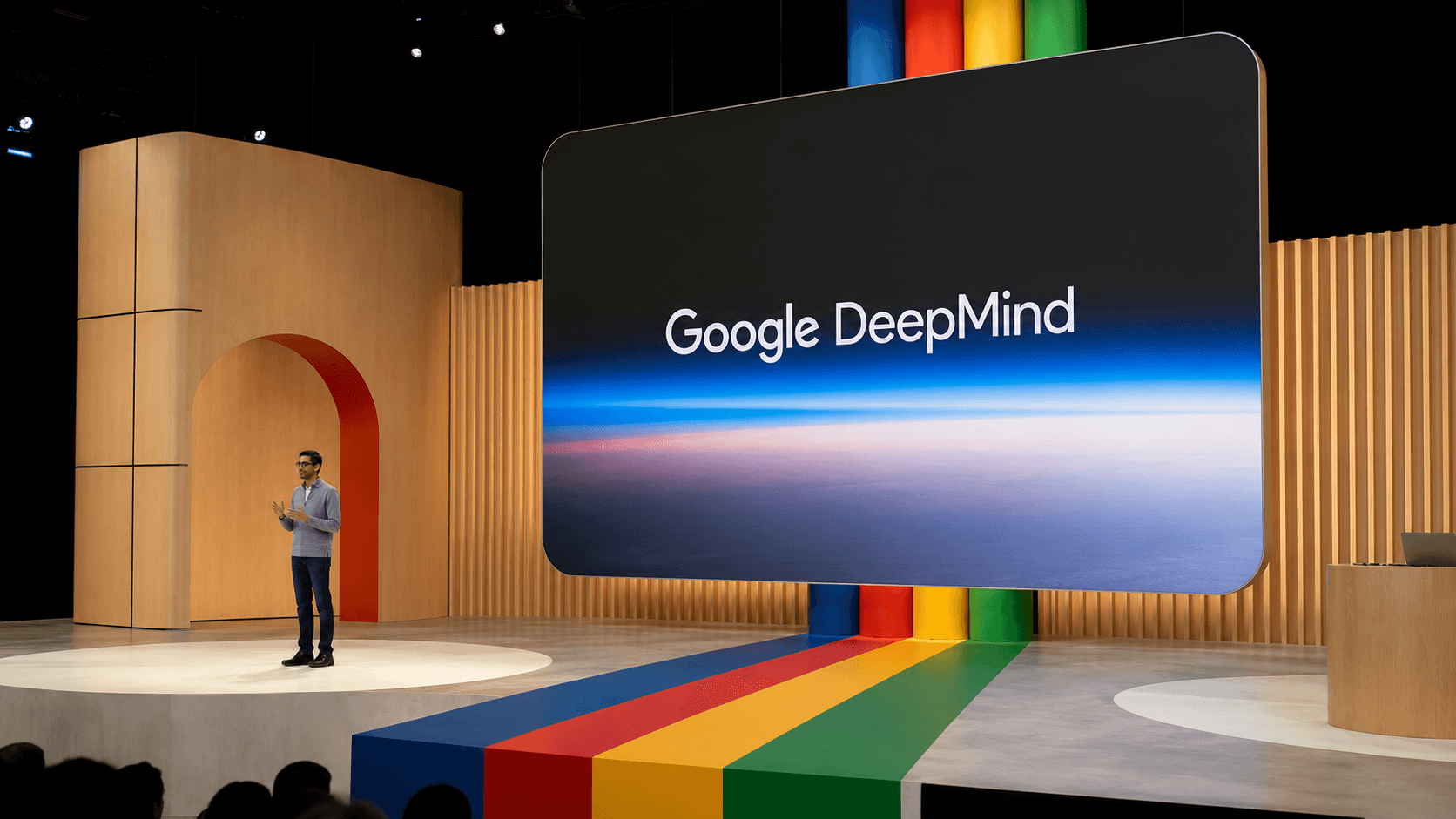
By the end of March, Reardon had hired around two dozen senior neuroscientists and AI researchers into a 10-story West SoHo building with a built-in data center. DeepMind researcher Greg Wayne, who runs Google's Project Astra, joined as a senior adviser after DeepMind CEO Demis Hassabis negotiated an arrangement letting Wayne spend 20% of his time at Flourish while keeping his day job. Flourish adviser Ben Recht, a UC Berkeley computer scientist, is on the technical side.
The scientific target is the cortical column, which one Flourish researcher calls the canonical computational unit of the brain. Investor and co-founder Jacob Vogelstein, who helped start the Open Connectome Project, sees the lab's brain-imaging work feeding directly into the model team. Co-founder Joshua Vogelstein recently co-authored a paper finding that a fruit fly's neural network is 10 times more efficient than a transformer — the kind of comparative result Flourish wants to turn into a design principle.
Competition is forming on the same thesis. Cortical Labs is wiring lab-grown neurons to silicon. Sam Altman is backing Merge Labs, which the founders describe as bridging biological and artificial intelligence. Meta's superintelligence group is marketing its TRIBE v2 model as a digital twin of human neural activity. A group called Unconventional AI is funding grants for biologically efficient AI research, and several venture firms now specialize in the category.
Reardon says Flourish has near-term revenue paths. The team is developing a hippocampus-inspired memory mechanism that would let models learn without extensive retraining, has built a continuously learning prototype, and is in talks with a major chip manufacturer to put the model onto silicon for pocket-sized devices. In early May, the company's scientists debated six candidate experiments — including connectome analyses in mouse versus human brains — that would require multimillion-dollar microscopy equipment and years of work.
The skeptical read is straightforward. Neuromorphic computing has been promised for decades and has not displaced the transformer, and Flourish has not yet published a result, shipped a product, or named a chip partner. A $2.5 billion valuation for a pre-revenue lab is priced on the team and the thesis, not on traction. Even Wayne, one of the highest-profile recruits, framed his decision as a bet on interestingness rather than on a known outcome.
What makes Flourish a market story rather than a science story is the capital structure. Bezos, Lux, and Google Ventures are funding a multi-year wet-lab program at a valuation that implies the answer, if it exists, is worth orders of magnitude more than the round. If the team finds even a partial architectural shortcut that cuts inference power by a factor of ten, the economics of every hyperscaler's training and serving stack change — and the buyers for that IP are the same companies currently spending tens of billions on transformer clusters. That is the trade Bezos is making, and it is why $500 million bought a research lab instead of a product.

Working on something we should cover, or seeing a story we missed? Send leads, documents, or feedback to hello@aichatdaily.com. For sensitive tips, see our secure tips page for Signal and PGP options.
Spotted an error? Email hello@aichatdaily.com with the URL and the issue, or read our full corrections policy.